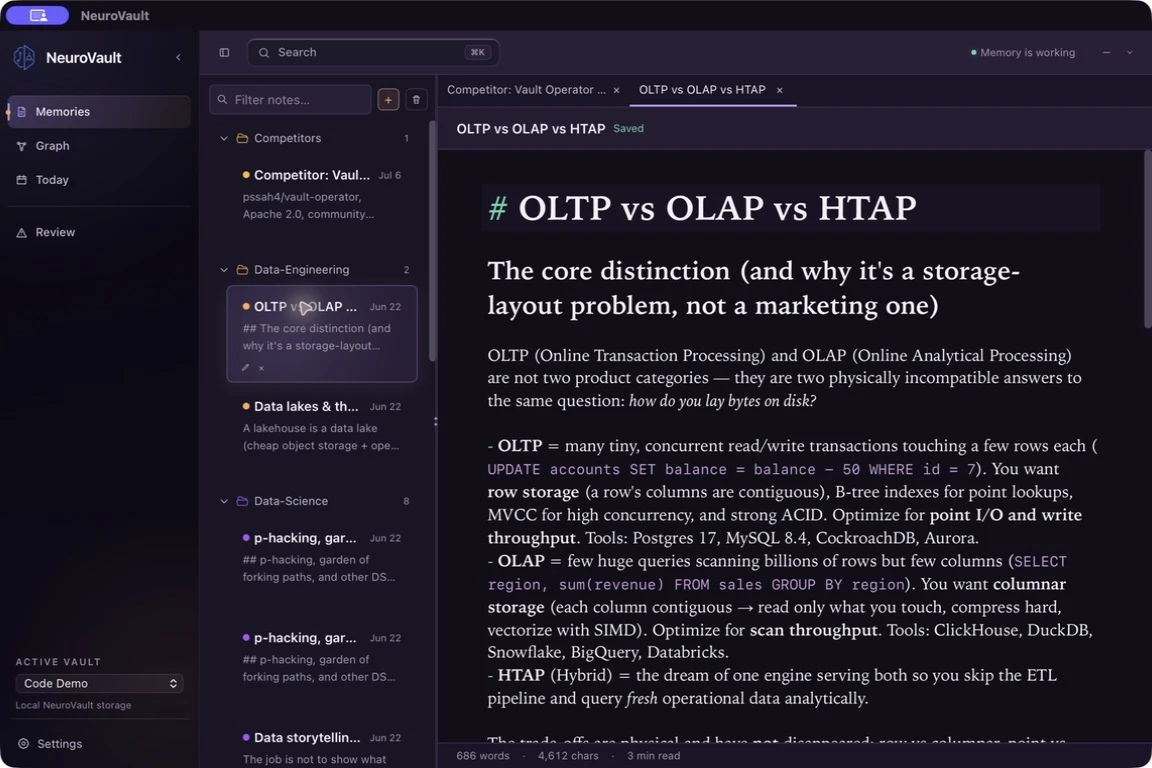
01 / Memories
Readable memory, not a black box.
Browse local Markdown, organize separate vaults, and edit what your agents are allowed to remember.

A brain for every agent you use. NeuroVault builds a durable memory base on your computer, then brings back the right context when your work needs it. Automatic for Claude Code. Available to any MCP-compatible agent.
Apple Silicon Mac, macOS 14 or newer · 28.2 MB · Intel Macs are not supported
Use the complete Mac app, or clone the same open source engine and configure it around your own agents.
$ git clone https://github.com/sirdath/NeuroVault.git
$ cd NeuroVault && node scripts/build-headless.mjs
FIG. 1. SEMANTIC (SQLITE-VEC) + BM25 + KNOWLEDGE GRAPH, FUSED VIA RECIPROCAL RANK FUSION, THEN RERANKED BY A CROSS-ENCODER. THAT STACK IS STANDARD GOOD PRACTICE, NOT A SECRET — SO WE BENCHMARKED IT IN THE OPEN RATHER THAN CALLING IT MAGIC. WHAT IS UNUSUAL IS THE REST. NO GENERATIVE MODEL READS YOUR DATA, NOT AT WRITE AND NOT AT READ: INGEST IS CHUNKING, ONNX EMBEDDINGS AND REGEX ENTITY EXTRACTION; RETRIEVAL IS VECTOR MATH, BM25 AND GRAPH TRAVERSAL. NOTHING TO LEAK TO, NOTHING THAT CAN HALLUCINATE A FACT INTO YOUR VAULT — ARCHITECTURE, NOT POLICY. EVERY HIT SHOWS ITS WORK (“SEMANTIC MATCH 0.82 (RANK 1) + KEYWORD MATCH (RANK 2); RERANKED 0.91”) PLUS KIND, DATE, THE AGENT THAT WROTE IT, AND THE PATH TO THE MARKDOWN FILE. RECALL RETURNS RANKED MEMORIES; RECALL_CHUNKS RETURNS THE MATCHING PASSAGES INSIDE LONG NOTES. THE MARKDOWN IS CANONICAL; THE INDEX IS DISPOSABLE AND REBUILDS.
Write and inspect memories, see how ideas connect, and understand when automatic context helped. The interface stays optional; the memory engine keeps working underneath.
Views 1–2 of 3
Browse local Markdown, organize separate vaults, and edit what your agents are allowed to remember.
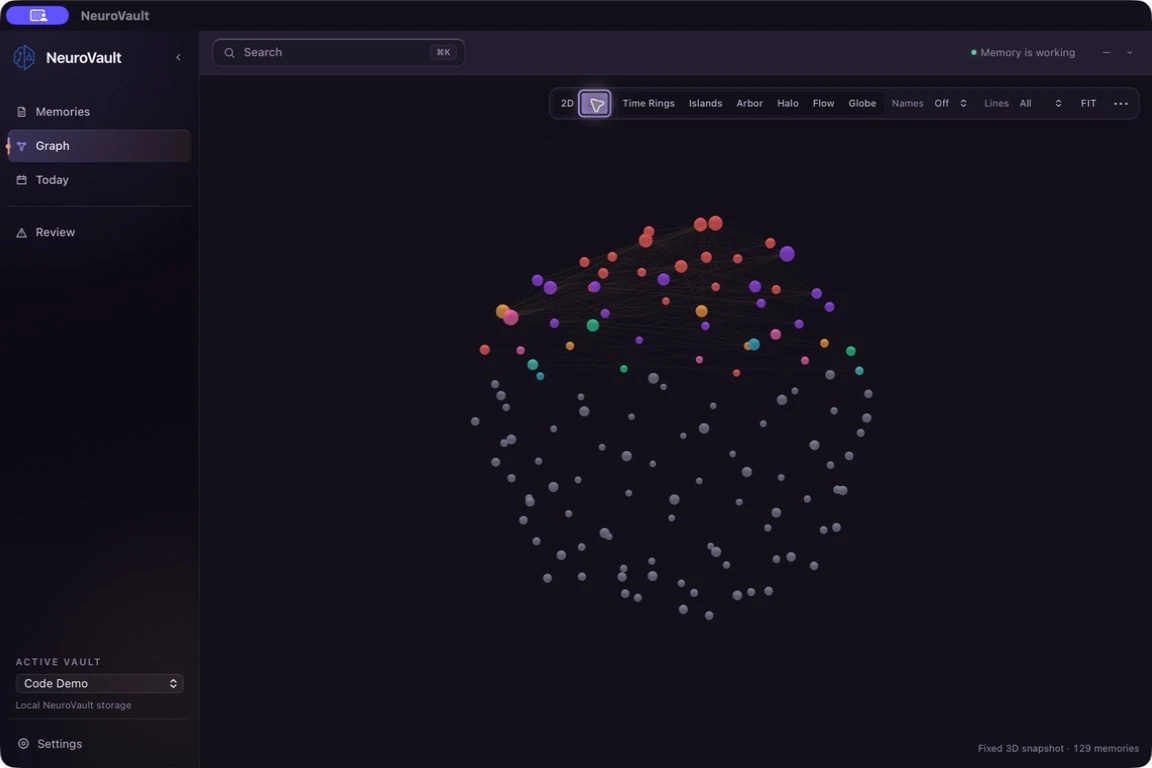
Explore the vector, keyword, wikilink, entity, and graph relationships inside your memory base.
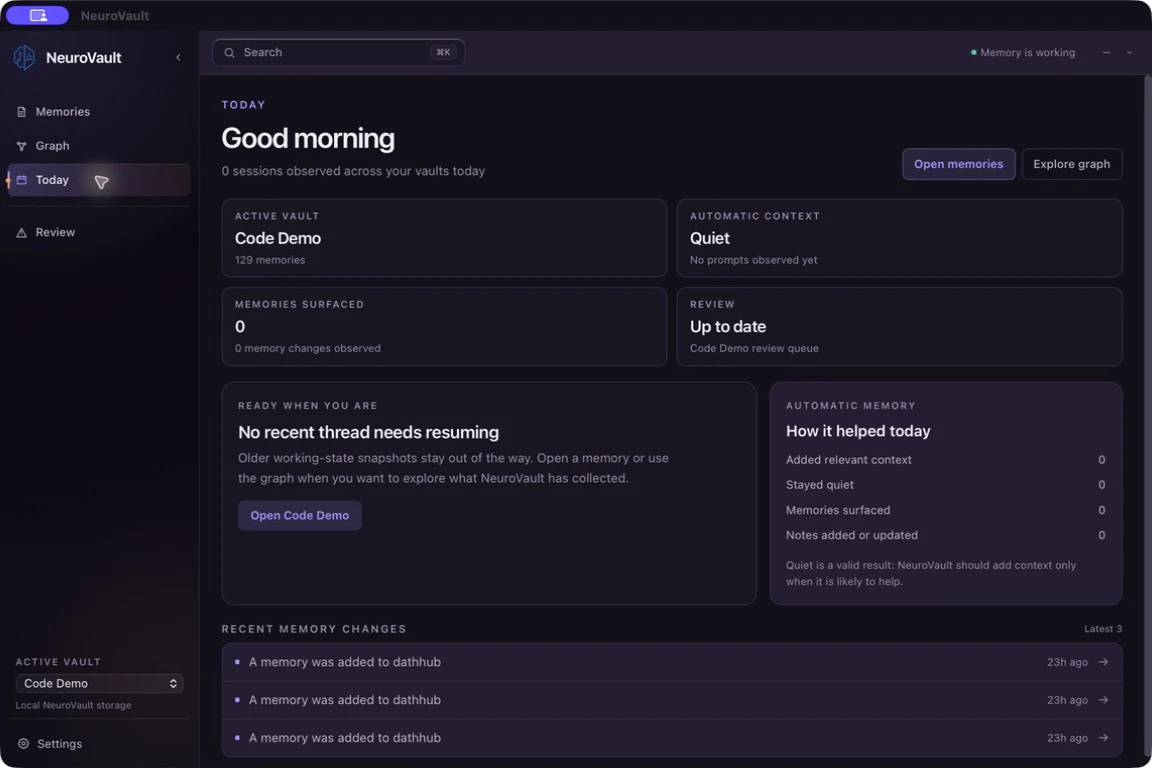
See automatic context activity, recent memory changes, the active vault, and anything waiting for review.
97.45%
HIT@5 · LONGMEMEVAL · NEUROVAULT’S REAL RECALL CODE PATH, BOOSTS ABLATED
This is retrieval recall, not an end-to-end QA leaderboard number. We publish it anyway — and we publish the caveat too: the harness ablates the recency and title boosts so the run is byte-reproducible, so this is the retrieval engine measured cleanly, not a stand-in for the exact production path.
In plain terms: ask it for a memory, and the right one is in the top five results 97 times out of 100, measured on 470 questions over long multi-session chat histories.
| HIT@5 | FULL 470-QUESTION SET | 0.9745 |
|---|---|---|
| RECALL@5 | STRICTER: ALL GOLD SESSIONS | 0.9383 |
| HIT@10 | SAME RUN | 0.9851 |
| HAYSTACK | ~50 SESSIONS PER QUERY | ~115K TOKENS |
| EMBEDDINGS | BGE-SMALL ONNX | 100% ON-DEVICE |
FIG. 2. AGENTS ROUTE WORK TO EACH OTHER AND READ THEIR OWN INBOX THROUGH ONE SHARED LOCAL BRAIN. HANDOFFS ARE PULL-BASED AND INERT; NOTHING AUTO-RUNS. SESSION_START(AGENT=X) SCOPES EACH AGENT’S VIEW TO ITS OWN RECENT MEMORY AND INBOX. A COORDINATION SUBSTRATE, NOT AN ORCHESTRATOR. THE AGENT WRITES BACK, AND CAN BE CORRECTED: REMEMBER ADDS, UPDATE FIXES, SUPERSEDE_NOTE RETIRES A STALE FACT SO IT DROPS OUT OF DEFAULT RECALL WITHOUT BEING DELETED, AND FIND_CONTRADICTIONS / RESOLVE_CONTRADICTION SURFACE AND SETTLE CONFLICTS REVERSIBLY.
NeuroVault has no account, telemetry, cloud sync, or NeuroVault-operated memory service. Note and engram content is stored as Markdown you can open with ordinary tools.
Read the exact privacy contract ↗Both paths use the same repository and the same local memory foundation. NeuroVault is free to use either way.
The visual app, memory browser, graph engine, review queue, settings, automatic context controls, and built-in local MCP server.
Clone the main repository, build the headless Rust server, and connect it to your own MCP clients or local applications.
$ git clone https://github.com/sirdath/NeuroVault.git
$ node scripts/build-headless.mjs
Memory that compounds
Start free. Keep the files. Let the memory base become more useful with every project, decision, and session.